





Eye For Film >> Movies >> Left-Handed Girl (2025) Film Review


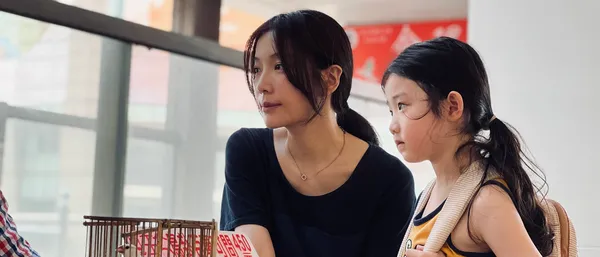

In Left-Handed Girl, the camera does not “lie” so much as refuse to perform. Stripped of the usual tools of embellishment, it works with available light and the stubborn givens of Taipei’s streets: cramped apartments, fluorescent night markets, faces caught mid-thought. Shih-Ching Tsou’s feature debut, co-written with Sean Baker, is fiction shot with documentary instincts. It is less interested in shaping reality than in entering it, letting the city’s textures do what production design and staging often overexplain.
Tsou follows a family of three as they move back to Taipei, mother Shu-Fen (Janel Tsai) and her two daughters, five-year-old I-Jing (Nina Ye) and young adult I-Ann (Shih-Yuan Ma). Their new apartment is tiny in the way that changes how people speak and breathe. There is no room to hide a mood. As they settle in, Shu-Fen begins setting up a noodle stand at a night market, a decision that is both practical and quietly heroic as it is work that exposes you, physically and socially, to the constant friction of other people’s appetites and judgments.
From the start, the central tension is domestic, not melodramatic. I-Ann reads as rebellious, but Tsou frames her less as a problem child than as a force of nature. She is a fighter, someone who forges her path by sheer insistence. The clash between mother and daughter is immediate, almost ambient, like the city noise outside the window. It is not a single argument so much as a way of living under one roof when love and resentment share the same air.
Then there is the extended family, and Left-Handed Girl gets brutally specific about how “family” can function as a hierarchy. Shu-Fen’s parents live in the city, but instead of being a safety net, they become another site of sorting and humiliation. They treat Shu-Fen and the girls as second-class relatives, especially when compared with their son and their other daughters. It is not just personal cruelty. It is a pattern, a preference structure that rewards male children and punishes women for taking up space, needing help or refusing to disappear. Tsou does not lecture this point. She shows it in glances, in who gets indulged, in who gets corrected, in who is treated like a burden even when they are doing the hardest work.
What redeems Left-Handed Girl from pure despair is how clearly it distinguishes blood from care. Shu-Fen’s relatives weaponise obligation and “saving face,” but at the night market – among people with no reason to help – small kindnesses accumulate. The other vendors become a kind of chosen family, offering understanding, flexibility and the simple dignity of not treating need as a moral failure.
The rawness and the truthfulness Tsou’s drama reaches for come partly from its method. Shot entirely on an iPhone, Left-Handed Girl catches the bustle of a working-class Taipei without turning it into a postcard. The city is not background. It is pressure. The streets are busy and unpredictable, and the family is constantly in motion, often perched on scooters as they thread through traffic, moving too fast to feel safe and too slow to feel free. There is a documentary immediacy to these passages, the sense of being in the middle of life rather than watching life packaged.
For all its specificity, Left-Handed Girl sometimes strains against the gravitational pull of Sean Baker’s sensibility. His imprint is most audible in the character writing and especially in the edit, the rhythm of escalation, the calibrated messiness, the way scenes seem to arrive already pre-shaped into “Bakerland” energy. It’s a testament to Tsou’s direction that her feature keeps returning to a quieter, more intimate frequency, but the question lingers: is this being allowed to fully read as a Shih-Ching Tsou film, or as a Sean Baker-backed extension of a familiar brand of street-level humanism?
But its real anchor is I-Jing, because the Taiwanese-American director understands that childhood is where “rules” first become theology. I-Jing is reprimanded by her grandfather for using her left hand to eat and draw, her dominant hand. He tells her it is a devil’s hand, one that does devil’s work. This is not just a quirky cultural detail; it becomes a mechanism of control, a way adults deposit fear into a child’s body. The title stops being metaphor and becomes a wound you can watch forming in real time.
That superstition becomes I-Jing’s crutch and her coping strategy in a household where money and stability are scarce. Left-Handed Girl is sharp about the anatomy of a child’s fear: how it is both irrational and perfectly logical, how it grows from overheard conversations and adult silences, how it becomes the most honest and heartbreaking thing in the world. I-Jing is constantly told not to speak because she is a child who should only listen, even though the film keeps suggesting she holds the clearest wisdom. At her grandparents’ apartment, I-Jing peers into the fish tank and remarks, “Fish are so stupid, they have no wisdom.” But the tank’s glass doubles as a mirror: behind it she catches her aunt eavesdropping while Shu-Fen asks her mother for a loan to keep the noodle stand alive. The line isn’t about fish at all; it’s a child’s coded diagnosis of adult cowardice.
Nina Ye’s performance is the film’s quiet miracle. She does not “act cute” or deliver precocious lines like a miniature adult. She lets us into I-Jing’s world seamlessly, with the kind of unforced openness that makes each small heartbreak feel uncomfortably real. When her sense of safety fractures, you can see it happen, not as a plot beat, but as a shift in how she looks at the room.
And this is where Left-Handed Girl’s tone plays its best trick. The upbeat score might suggest an easy watch, something warm and breezy, a slice-of-life comedy you can digest over a bowl of noodles. Tsou does offer warmth, especially through the idea of chosen family, the fleeting moments where kindness arrives from outside the bloodline. Those moments matter, because without them the film would be almost unbearable.
But do not mistake the film’s surface liveliness for comfort. Underneath the bustling night market and the scooter rides is a story about trauma, about revelations that do not resolve neatly, about the traditional imperatives of saving face and the particular weight of being a woman without a stable income. Left-Handed Girl is bearable because it is alive, not because it is gentle. It has the courage to show how people endure, and how endurance can look like love from one angle and like resignation from another.
Reviewed on: 22 Dec 2025